*This post may contain Amazon affiliate links or affiliate links from other companies, which means The Musically Sound earns a percentage of sales from any qualifying purchases at no additional cost to the buyer. Learn more on our Private Policy page.
If you’re new to the world of guitar playing, certain accessories can benefit any guitarist’s toolbox. One of these is the capo.
If you’ve sat in on a jam session, attended an open mic, or listened to songwriters perform at the Bluebird Cafe in Nashville, you’ve likely seen a capo clamped on at least one performer’s guitar neck.
And if you’re new, you’re probably thinking… what is that?
A guitar capo is one of the simplest tools you can use for standard fretted stringed instruments, valuable because it opens up a ton of possibilities. It can change keys, make songs easier to play, and help you match a singer without relearning everything.
Here’s the breakdown of most everything you need to answer the question, What is a guitar capo?”
What Is a Guitar Capo?
A guitar capo is a small clamp that attaches to your guitar’s neck and presses down all the strings at a specific fret. When you put a capo on, you’re basically creating a new “starting point” for the guitar. The fret where the capo sits becomes your new open position.
So instead of playing open chords at the nut, you can play them higher up the neck. That’s the core idea behind a guitar capo explained.
What Is a Guitar Capo Used For?
This is where most people start asking questions.
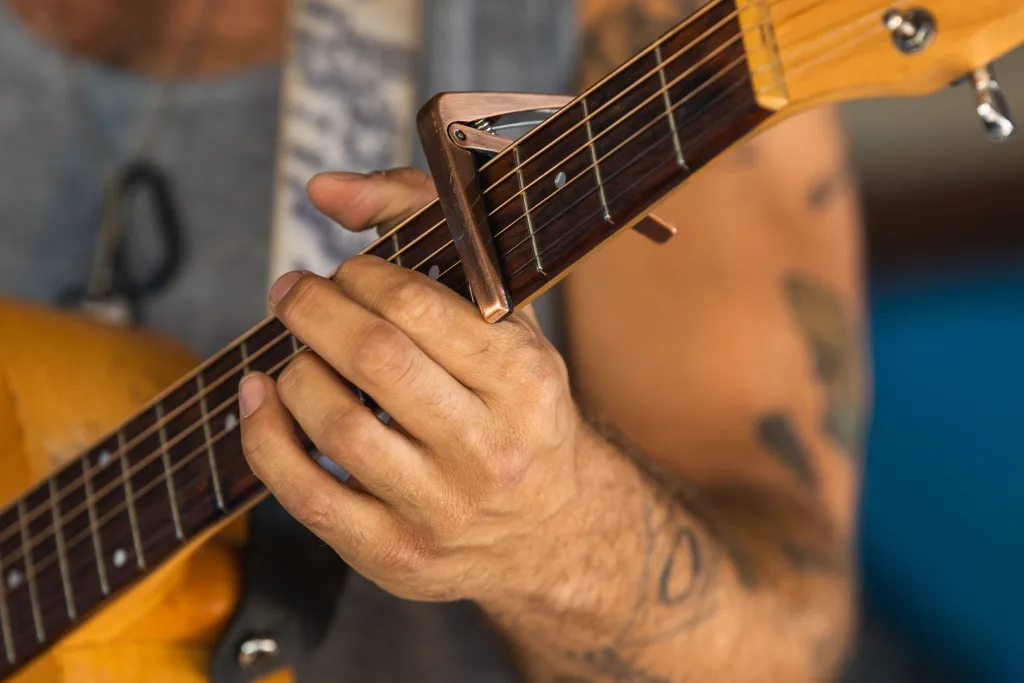
A capo is used for three main things:
1. Changing Keys Without Retuning
The main magic behind a capo is that you can play the open chord shapes you are familiar with, but the capo allows you to play them in a different key.
Many guitarists have keys they prefer to play in because of familiarity, easier voicing options, and more. You can take that musical comfort zone and move anywhere you want on the fretboard.
2. Making Songs Easier to Play
Some keys are genuinely harder to play in than others on guitar. F, B-flat, and E-flat, for example, don’t sit as naturally under the fingers as G, D, A, or C. A capo lets you access those keys while using the chord shapes you already know.
This is particularly useful when playing with horn players, pianists, or other instruments that tend to favor flat keys. Instead of wrestling with barre chords all night, you find a capo position that maps your comfortable shapes to the key everyone else is playing in.
It’s also worth noting that this isn’t a beginner’s shortcut — professional session guitarists use capos strategically for exactly this reason. It’s a tool, not a crutch.
3. Matching a Singer’s Vocal Range
This is probably the most common real-world use of a capo, especially for singer-songwriters and accompanists.
Every vocalist has a comfortable range, and songs don’t always land in the right key for a given voice out of the box. Rather than transposing chord shapes into an awkward key full of barres and stretches, you simply find the capo position that puts your open-position chords in the right key for the singer.
If you’re accompanying someone who sings better in B than in G, capo the second fret and play your G shapes. Done. It’s one of those solutions that feels almost like cheating until you realize it’s just smart playing.
4. Changing Tone and Texture
Here’s a use that gets less attention but matters a lot in recording and arranging: a capo changes the way your instrument sounds, not just the pitch.
When you capo up the neck, the vibrating string length gets shorter. This produces a brighter, more chime-like tone with a slightly different resonance than the same notes played lower on the neck. Two guitarists playing the same song — one without a capo, one capoed at the fifth fret using different shapes — will produce a fuller, richer combined sound than two guitars playing identical voicings. This layering technique shows up constantly in recorded music, including a lot of country, folk, and bluegrass.
So if you’ve ever heard people ask, “Why do guitarists use capos?” — these are the main reasons.
What Does a Capo Do?
So what does a capo actually do?
A capo shortens the vibrating length of the strings. When the strings are shorter, the pitch goes up.
When you clamp a capo across a fret, it acts as a new nut, raising the pitch of every open string by the same amount. Place it on the second fret, and every string goes up a whole step. Place it on the fifth fret, and you’ve raised the pitch by a perfect fourth.
To put it more simply:
- Capo on 1st fret → up one half step
- Capo on 2nd fret → up two half steps
- And so on
That’s the simple version of how a capo works.
Your chord shapes stay exactly the same. A G chord shape with a capo on the second fret produces an A chord. A D shape with a capo on the third fret gives you an F. You’re playing familiar shapes but landing in different keys, which is the whole point.
Guitar Capo Chart (Quick Reference)
Then use a beginner-friendly guitar capo chart like this one:
| Capo Fret | Raise Pitch By | Example: G Shape Sounds Like |
|---|---|---|
| 1 | 1 half step | G# / Ab |
| 2 | 2 half steps | A |
| 3 | 3 half steps | Bb |
| 4 | 4 half steps | B |
| 5 | 5 half steps | C |
| 7 | 7 half steps | D |
How to Use a Capo (Step-by-Step)
This is where beginners usually get tripped up. Here’s the right way to use a capo on guitar:
Step 1: Place it just behind the fret
Do not place the capo on top of the fret, nor in the middle of it. That sweet spot where you’ll get the best intonation is just behind the fret bar.
Step 2: Apply even pressure
Make sure all strings ring clean. Depending on the type of capo you have, you may need to apply a little pressure or make adjustments to make sure the 1st and 6th strings are also depressed.
Step 3: Check for buzzing
If any of the strings buzz, adjust slightly or reposition the capo.
Step 4: Play like normal
Your chord shapes don’t change—just the sound. So finger the chords the way you always did.
That’s the basics of how to use a capo step by step.
Where to Place a Capo on Guitar
This depends on the song. There’s no “correct” fret—it’s all about the key you want.
That’s why people search things like:
- what fret should I put my capo on
- where to place a capo on guitar
The answer is always the same:
👉 Wherever it sounds right for the song and singer. That’s the easy answer—if you play by ear.
However, there is a method behind this. If you know the names of the chords you are playing, or the key you are in, you can make adjustments quickly, especially if you are in a band or jam setting where musicians have to adapt quickly.
A specific example: You want to use open chords in the key of G major. The root of the G chord is on the 3rd fret of the 6th string—the G note.
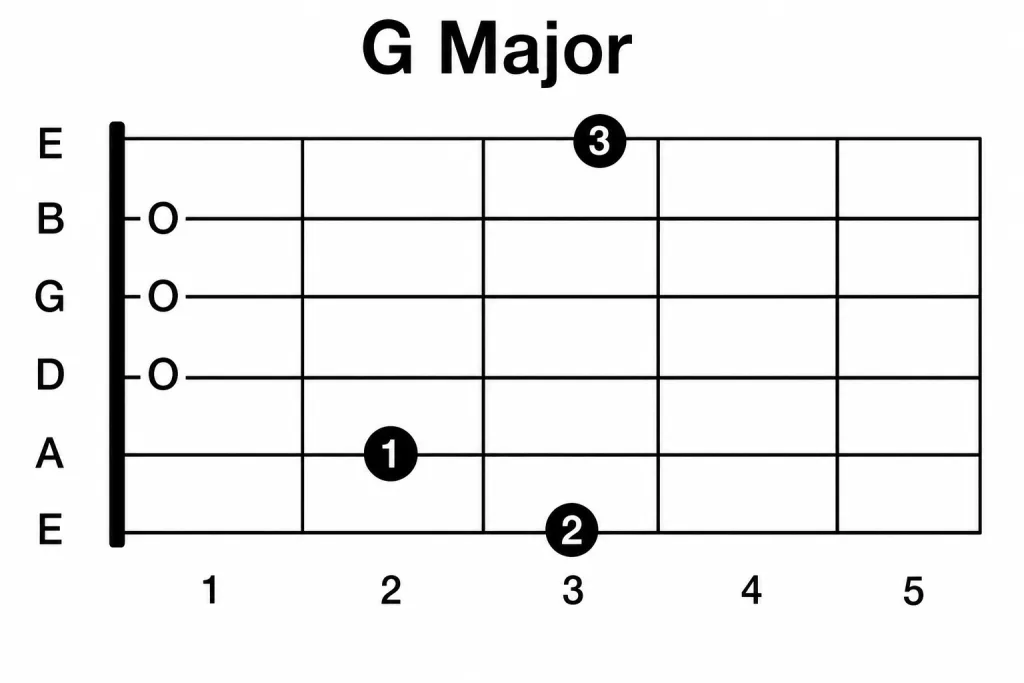
If you put the capo on the 2nd fret, when you now make a G major chord shape, the root will be fingered on the 5th fret. You’ll be playing in the key of A—one full step up. Go another full step up by placing the capo on the 4th fret, and your G chord shape will “sound” like a B major chord.
If you want an easy approach to a more structured process, you can use a capo chord chart. However, many players learn how to use capos by ear over time.
Does a Capo Change the Key or Pitch?
This question confuses a lot of people.
Short answer: both
- It raises the pitch
- Which changes the key
So if you play a G chord shape with no capo, it’s G.
Put a capo on the 2nd fret and play the same shape… now it’s A.
That’s exactly how a capo changes key.
Capos on Banjo, Ukulele, and Mandolin
Capos aren’t just a guitar tool. They show up across the stringed instrument family, though with some differences worth knowing.
On banjo, capos are used frequently — particularly in bluegrass, where players need to shift keys to match singers or other instruments without retuning mid-set. Partial or spike capos are also common on banjo, clamping only some strings to achieve specific open tuning effects.
On the ukulele, a capo works the same way as on a guitar. It’s especially useful for players who accompany singers, since ukulele voicings are already fairly limited and transposing by hand can get awkward quickly.
On mandolin, capos are used but less universally. Mandolin players often prefer to transpose chord shapes or shift positions, but for melody-focused players or those accompanying in unfamiliar keys, a capo is a practical solution.
Types of Capos Worth Knowing and What to Buy
Capos come in several designs, each with tradeoffs. Here are the main types and some reliable options across each category.
Spring-loaded capos are the most common. You squeeze, clamp, and release — fast and easy, which makes them popular for live performance where you’re changing keys between songs. The Kyser Quick-Change is the classic example. It’s been the go-to for decades, grips reliably, and comes in versions for guitar, banjo, and ukulele. The tradeoff is that spring tension is fixed, which can cause slight tuning inconsistencies on some necks.
Screw-tension capos let you dial in exactly how much pressure is applied, which tends to produce better intonation. The Shubb C1 is the gold standard here — used by professionals worldwide, built to last, and available in steel and nickel. It takes a second longer to apply than a spring capo, but many players consider the tuning accuracy worth it.
Partial or cut capos clamp only certain strings, leaving others open. This opens up alternate voicings and drone effects that a full capo can’t produce. The Third Hand Capo and various partial capo designs from Kyser are worth exploring if you want to experiment with this approach.
Trigger capos are a middle ground — faster than screw types but with slightly more adjustability than pure spring designs. The G7th Performance 3 is a well-regarded option in this category, with an adaptive tension mechanism that adjusts to your neck profile automatically. It’s on the pricier end but earns its cost in consistent intonation.
Roller capos allow you to slide the capo up and down the neck without fully removing it, useful for songs that modulate keys mid-performance. The Shubb F-1 FineTune Yoke Capo and Franklin Strap Glider both offer this kind of functionality with a premium feel.
For most beginners, a Kyser Quick-Change or Shubb C1 is the right starting point. Both are under $25, widely available on Amazon, and built well enough to last years of regular use.
Best Guitar Capos (My Recommendations)
Now that you actually understand how a capo works, this part will make more sense.
Here are a few solid options based on different needs.
Best Capo for Beginners (Fast & Easy): Kyser Easy-Switch Acoustic Guitar Capo
 Kyser Easy-Switch Acoustic Guitar Capo (Rosewood)
 The world's most trusted capo, handcrafted in Texas with aircraft-grade aluminum and a steel spring for reliable, one-handed string transposition on acoustic guitars.
- Original Quick-Change design allows fast, one-handed capo placement and removal
- Strong yet lightweight construction made from genuine aircraft-grade aluminum with steel spring
- Parks conveniently on the guitar's headstock when not in use for quick access
- Available in 15+ different colors and finishes to match any guitarist's personality and style
- Made in the USA with a lifetime guarantee — professional quality built to last
This is the one most people start with. It’s quick. It’s simple. You can move it with one hand mid-song.
The tradeoff? You don’t control the tension, so you may have to double-check the tonality based on where you place it. But for most players, that’s not a dealbreaker.
Best Capo for Accuracy & Tuning Stability: Shubb C1 Acoustic Guitar Capo
 Shubb C1 Standard Acoustic Guitar Capo
 A precision-engineered capo with a patented adjustable design, trusted by players for decades for its tuning stability and consistent performance.
- Iconic design used and trusted by musicians for over 35 years
- “Set it and forget it” adjustable tension—no need to readjust every time
- Smooth lever action makes locking and removal quick and easy
- Custom rubber grip applies even pressure like a fingertip to help keep your guitar in tune
- Durable nickel-plated brass construction built for long-term reliability
My first quality capo was the Shubb C1. You can adjust the tension to adapt to any acoustic guitar neck, and the grip will always be solid, making for clear intonation and better control.
Essentially, you get:
- Better tuning
- More control
- Less chance of pulling strings sharp
If you care about tone, try this capo.
Best Budget Option: Sound Harbor Guitar Capo with Pick Holder
 Sound Harbor Guitar Capo with Pick Holder
 A simple, budget-friendly capo with a built-in pick holder, designed for quick key changes and everyday playing.
- Spring-loaded design for fast, one-handed repositioning
- Built-in pick holder keeps your picks within reach
- Compatible with most 6-string acoustic and electric guitars
- Even pressure helps reduce buzzing and maintain clean tone
- Lightweight aluminum build with soft padding to protect your neck
I own this capo as a backup, and it definitely does the trick. It’s a simple, affordable capo that still offers solid performance.
I like the reverse angle where the handle is under the neck, which actually makes for an even smoother transition between frets. Plus, the pick holder is handy when swapping between strumming and fingerstyle guitar.
Best Premium Capo
 G7th Performance 3 ART Capo
 A premium capo with adaptive tension control and precision engineering, built for maximum tuning stability on both acoustic and electric guitars.
- Adaptive Radius Technology automatically matches your fretboard for clean, buzz-free tone
- Unique squeeze-to-set tension system for quick, one-handed adjustments
- Maintains strong tuning stability across different neck shapes
- Soft silicone pads protect your guitar without marking or scratching
- Sleek, professional design built for reliability on stage or at home
If you’re looking a player looking for a high-end capo with fine adjustment and maximum precision, this is a pro tool.
The trick behind it is the Adaptive Radius Technology, which allows it to adjust naturally to whatever guitar you’re playing, delivering a clean, precise tone without fret buzz.
The design also protects your guitar from damage to the wood from over-squeezing. That makes it even more worth the higher price tag.
Frequently Asked Questions About Capos
Can you use a capo on any guitar?
Yes, as long as you use a capo designed for your guitar type. Most capos work on acoustic and electric guitars, while classical guitars often require a wider capo that fits their flatter fretboard correctly.
Do capos damage guitars?
No, a properly fitted capo won’t harm your guitar during normal use. However, excessive pressure or leaving a capo clamped on the neck for long periods can potentially affect the finish or cause tuning issues.
Is a capo necessary for beginners?
No, you can learn guitar without one, but a capo makes many songs easier to play. It allows beginners to use familiar open-chord shapes while playing in different keys, reducing the need for difficult barre chords.
Is using a capo cheating?
No, using a capo is a normal technique used by beginners and professional musicians alike. It helps match songs to a singer’s vocal range, creates different tonal colors, and simplifies certain chord progressions without changing the music itself.
What is a Guitar Capo? A Small Tool With a Big Job
A guitar capo is one of those tools that seems simple until you realize how much it can do.
While it doesn’t replace technique, a capo does extend what you can do with the technique you already have. Whether you’re matching a singer’s range, unlocking a cleaner chord voicing, or layering textures in a recording, it earns its place on the headstock every time.
If you’re just starting out:
- Grab something easy (like a Kyser)
- Learn how to use a capo for beginners
- Start experimenting
From there, you’ll figure out what you actually need.
If you don’t own one yet, start simple and get playing. You’ll find uses for a guitar capo faster than you expect.
*This post may contain Amazon affiliate links or affiliate links from other companies, which means The Musically Sound earns a percentage of sales from any qualifying purchases at no additional cost to the buyer. Learn more on our Private Policy page.