*This post may contain Amazon affiliate links or affiliate links from other companies, which means The Musically Sound earns a percentage of sales from any qualifying purchases at no additional cost to the buyer. Learn more on our Private Policy page.
Article author Abby Parks has been a mandolin instructor for many years, utilizing the instrument in solo performances and with the old time band On the Fence. A former leader of an old time music jam, she has taught students who went on to compete in mandolin contests. She holds a B.A. in Music Performance with classical guitar emphasis and has taught private lessons since 1996. Her recommended mandolin beginner repertoire books are ones she’s personally worked with or analyzed as a mandolinist and instructor, providing direct insight into their effectiveness for students.
Banner photo: Mandolin. JPG by © Photo Bungler / CC BY-ND 2.0
There are several paths to learning the mandolin, and the right approach depends largely on an individual’s learning style. While one-on-one lessons are always valuable, many players prefer a self-directed route—learning by listening, watching, and imitating, much like traditional front-porch pickers and early bluegrass musicians, some of whom attained greatness (like Uncle Pen Vandiver and his nephew Bill Monroe). Today, that can mean video lessons, online courses, or working through beginner mandolin books at your own pace with a clear, structured plan.
As a mandolin teacher with many years of experience, I’ve worked through a wide range of mandolin instruction books, both personally and with students. Some of the best beginner mandolin books have been around for decades, while newer options often improve on pacing and include helpful audio or video companions. True beginners tend to benefit from a mandolin method book that clearly explains tuning, tablature, rhythm, and basic music theory, while those who already play a stringed instrument like the guitar or banjo may prefer mandolin books for beginners that move more quickly into songs.
Beyond general methods, many mandolin books for beginners are geared toward specific styles, including bluegrass, old-time, blues, Irish, and classical. Below, you’ll find the best beginner mandolin books in 2026 for a range of goals and experience levels—method books, songbooks, and style-specific resources that can help you build a solid foundation and stay motivated.
First Glance at the Best Beginner Mandolin Books
| Product Image | Product Name / Primary Rating / Price | Primary Button |
|---|---|---|
Overall Best Beginner Mandolin Method |
| |
Best Method for Quick Learning |
| |
Best for Note Reading Basics |
| |
Best Fretboard & Position Method |
| |
| ||
Best Mandolin Lick Book |
| |
Best Classic Bluegrass Method |
| |
Best Next-Level Mandolin Study |
| |
Best Primer for Irish Tunes |
| |
Best Classical Mandolin Method |
| |
Best Beginner Irish Method |
| |
Best Blues Mandolin Book |
| |
Best Basic Fakebook |


Can I learn to play effectively from a mandolin method book?
I first started learning stringed instruments with books. I’ll grant you, I was 12 when I got my first guitar and only made it to the second or third string trying to teach myself that way. Two years later, I enrolled in a class, which helped immensely, as I was a complete beginner and needed guidance. For that reason, I do recommend that young students begin with a teacher. Once I had a foundation, though, I was able to learn multiple instruments using mandolin method books and other instructional materials. I also believe that a “total beginner” who is a teen or older can work through beginner mandolin books independently, provided the book supports their learning style. The mandolin is especially well-suited to book-based learning thanks to its logical tuning, compact fretboard, and the widespread use of mandolin tablature books.
Because I studied music throughout my teen years and eventually became a music major, learning from books became second nature for me. When I took up the mandolin, I leaned heavily on mandolin instruction books to build technique and repertoire, and even started an Old Time jam to help a student apply material learned from mandolin songbooks in a group setting. Over the years, I’ve worked through a wide range of mandolin books for beginners and beyond, and the best ones share a clear, practical format that moves step by step without overcomplicating things.
Learning the mandolin from a book is absolutely achievable—I’ve done it myself. With the right beginner mandolin book, a motivated student can make solid progress in a relatively short period of time. That said, not all mandolin books for beginners are created equal. Success often comes down to prior musical experience and choosing a method that fits how you learn best.

What To Look For in a Mandolin Teaching Book
Before diving into specific recommendations, it’s important to understand what separates a good beginner mandolin book from one that will cause frustration. Below are some key elements I look for in a well-rounded mandolin method book that actually supports long-term progress.
Pick Technique and Right-Hand Fundamentals
Mandolin tone, speed, and clarity are largely determined by right-hand technique. A solid mandolin beginner book should clearly explain how to hold the pick, how to approach single-note mandolin playing, and how to execute basic mandolin tremolo. Another picking approach that is characteristic of the instrument is arpeggiated mandolin playing. Because the mandolin has doubled strings, arpeggios play a major role in overall technique development. Without clear mandolin picking technique guidance, beginners often develop habits that are difficult to undo later.
Basic Mandolin Chords and Fretting Technique
Even melody-focused mandolin players need to understand basic mandolin chords and proper left-hand technique. A good beginner mandolin method should introduce open mandolin chords, simple two-finger and three-finger shapes, and demonstrate how those shapes can move around the fretboard, since relying only on open chords becomes limiting fairly quickly. A strong mandolin teaching book should also explain how the instrument functions in ensemble settings, especially in bluegrass and folk music. For example, in bluegrass, mandolin chop chords are just as important as open strumming for their percussive role.
How To Read Mandolin Tablature (and Standard Notation)
Most modern mandolin instruction books rely heavily on mandolin tablature, often presented alongside standard notation. A beginner-friendly mandolin TAB book should explain tablature clearly and gradually, without assuming prior reading experience. For students interested in classical mandolin or ensemble playing, exposure to standard music notation is essential. If your goal is to learn to read music for mandolin (which I believe is highly important for any musician, particularly when it comes to rhythm), a solid method that teaches notes up to at least the 5th fret is an excellent starting point.
Basic Music Concepts and Instrument Setup Tips
Strong mandolin method books include foundational concepts such as rhythm, timing, note values, and proper tuning. Clear explanations of posture, left-hand pressure, pick control, and common beginner mistakes can dramatically improve how quickly a student progresses and help reinforce good mandolin technique early on.
Practical Mandolin Repertoire That Builds Real Skills
Mandolin shines in traditional music settings. A strong beginner mandolin book should include practical, recognizable tunes from bluegrass, old-time, folk, Irish, or blues mandolin traditions—songs students are likely to encounter at bluegrass jams or other group playing situations. Well-chosen mandolin repertoire should progress logically in difficulty while reinforcing techniques introduced earlier in the book.
The Best Mandolin Books For Beginners
Below is my curated list of the 13 best beginner mandolin books in 2026 that work exceptionally well for beginners and developing players. Some are complete methods, while others are best used as companion books to help round out technique, repertoire, or stylistic knowledge of the mandolin.
1. Overall Best Beginner Mandolin Method: Beginning Mandolin — Greg Horne
When I took up the mandolin seriously, Beginning Mandolin by Greg Horne was the perfect choice, especially since I was already a stringed instrument player. Right from the start, it’s worth noting that this mandolin method book can be purchased in three separate volumes. If you’re looking for a strong mandolin learning springboard but want the flexibility to explore other methods, I recommend checking them out individually:
- Beginning Mandolin by Greg Horne
- Intermediate Mandolin by Greg Horne
- Mastering Mandolin by Greg Horne (not available)
Because each mandolin instruction book typically costs over $20, most students will be well served by purchasing the complete mandolin method edition, which is featured below and offers the best overall value.
This comprehensive beginner mandolin book gives the advancing mandolin beginner broad coverage of musical styles, including traditional fiddle tunes, bluegrass mandolin, rock and pop, blues, and even jazz mandolin concepts. Tunes like Soldier’s Joy, Lil’ Liza Jane, Old Joe Clark, and Mississippi Sawyer aren’t just treated with bare-minimum nods. Instead, the student is guided through related mandolin scales, targeted exercises, and in some cases, second or third variations of each tune to reinforce musical ideas. These lessons incorporate techniques like passing tones, drones, shuffle patterns, double stops, unison doubles, and tasteful mandolin ornamentation. Essential techniques such as mandolin tremolo, hammer-ons and pull-offs, and movable mandolin chord shapes are all covered in the first book alone.
The intermediate mandolin method showcases speed-building exercises, cross-picking technique, and a deeper dive into fiddle tunes, featuring more bluegrass picking patterns. Students are introduced to mandolin bluegrass break, along with ragtime and blues mandolin. Beyond the basic scales presented in the beginning book, intermediate students learn movable major, minor, and pentatonic mandolin scales, with practical tips for connecting scale patterns across the fretboard. Swing and jazz mandolin are also introduced with chord studies covering voicings for major and minor 7th chords, major 6ths, and more. For the student moving on to master the mandolin, the later material expands into advanced mandolin chord forms, deeper music theory, and more demanding applications.
Who will benefit most from this comprehensive mandolin book method?—a student with some knowledge of some core music basics. The book does not methodically teach note reading on the mandolin string-by-string for the ultra-beginner. While this series is my go-to mandolin teaching method for students, I usually provide some pre-teaching material for those who don’t have core note-reading skills. Some students may also not prefer a method that covers so many genres. If your heart is set on bluegrass mandolin alone, you may want to lean into a more focused method. But with the wealth of information covered, this complete mandolin method is my overall best pick.
- Comprehensive mandolin method covering beginner through advanced techniques, all in one volume.
- Teaches reading music and TAB, basic strumming, alternate picking, tremolo, slides, and genre styles like bluegrass and blues.
- Progresses into intermediate and advanced topics such as hammer-ons, pull-offs, cross-picking, rolls, harmonies, chord-melody, and improvisation.
- Includes online audio demonstrations of examples so students can hear how exercises and styles should sound.
- Well-paced, step-by-step organization makes it suitable for self-study or teacher-led learning.
- Extremely comprehensive, taking a student from basics through more advanced mandolin concepts in one book
- Covers bluegrass, blues, and other styles rather than focusing on just one genre
- Helpful online audio included supporting learning with clear sound references for exercises and songs
- Can be a steep learning curve for absolute beginners with no musical experience
- May advance too quickly for students looking only for the very basics of mandolin technique
- Not genre-focused, so not the best method for building specific repertoire
2. Best Method for Quick Learning: Mandolin Primer — Bert Casey
Mandolin Primer by Bert Casey is a strong contender among mandolin books for beginners, especially for players whose primary goal is to get into bluegrass-style playing as quickly and practically as possible. Much like the other Primer-style methods in the Watch-&-Learn series, this book focuses less on abstract concepts and more on showing the student how real mandolin songs function in a traditional setting. By the end of the book, the student walks away with a usable starter repertoire of classic tunes that naturally translate to jam situations.
The material is presented in a very song-centered way. Tunes are introduced gradually, often supported by short, focused exercises that isolate the techniques or phrases found in the arrangement. When the student moves on to the full tune, those ideas are immediately recognizable, which makes the learning process feel manageable rather than overwhelming. The book is heavily mandolin tablature–based, making it accessible for self-learners who may not read standard notation fluently, though basic rhythmic awareness is still required to make the most of the material.
One of the biggest strengths of this mandolin instruction book is the included video and audio support. Songs are demonstrated clearly, and play-along tracks at multiple tempos help the student increase speed gradually, which is a key factor in not only improving picking skills, but in developing that needed speed factor to jam with other players. That said, this is not a technique-heavy or theory-focused mandolin method book. It doesn’t spend much time on fretboard theory, scale systems, or improvisation concepts. Instead, it works best as a mandolin beginner repertoire book that builds confidence, timing, and familiarity with common bluegrass forms. Players who want a more technical or theory-based method will likely want to pair this with a more comprehensive mandolin technique book as they go beyond the basics.
- Step-by-step mandolin method designed specifically for beginners
- Teaches fretting, picking, basic chords, rhythms, and simple melodies
- Uses clear tablature alongside standard notation for faster learning
- Includes video access to demonstrations for visual reinforcement
- Progresses logically from fundamentals to easy repertoire and technique
- Very beginner-friendly pacing
- Includes instructional video content
- Clear layout with tablature and notation
- Limited advanced technique coverage
- Basic repertoire only
- Video quality varies in usefulness

3. Best For Note Reading Basics: Hal Leonard Mandolin Method Book 1 — Rich DelGrosso
The Hal Leonard Mandolin Method Book 1 by Rich DelGrosso follows the familiar Hal Leonard formula: thorough, clearly paced, and built to give a true beginner a solid foundation. As with other books in this series, the emphasis is on fundamentals—proper posture, pick grip, basic left-hand positioning, and most notably, note-reading skills. This is one of the stronger beginner mandolin books when it comes to learning how music actually works on the page. Standard notation is introduced early and reinforced consistently, with mandolin tablature included as a parallel system rather than a crutch. Rhythm, timing, and basic musical symbols are explained gradually, making this a good mandolin beginner method book for players with little to no prior musical experience who want to focus on their picking skills.
The repertoire leans heavily toward familiar folk and traditional material, with simple arrangements of songs like Boil Them Cabbage Down, Skip to My Lou, Aura Lee, Old Joe Clark, and other traditional tunes commonly found in early mandolin instruction books. While bluegrass is present, the book also pulls from old-time, folk, and pop, which keeps things approachable for younger students or complete beginners. Audio support allows students to hear the examples and play along at manageable tempos, reinforcing pitch and rhythm accuracy.
One factor to note is that the book does not focus on chording. Chord charts are virtually non-existent. If you want to focus on the rhythmic side of mandolin playing, a supplemental chord dictionary book or a more chord-focused method like Fretboard Roadmaps for Mandolin might be the route to take. Additionally, players coming from another stringed instrument may find the early pacing slow, but for someone whose main goal is learning to read music and understand the mandolin fretboard from the ground up, this remains one of the more reliable beginner mandolin books available.
- Structured mandolin method with basic music concepts
- Covers fundamentals: fretting, basic rhythms, picking, and simple chords
- Uses tablature and standard notation to teach reading music
- Includes familiar folk and traditional melodies for practice
- Designed for self-study or teacher-assisted learning
- Easy for complete beginners
- Balanced tablature and notation focus
- Teaches core basics clearly
- Limited advanced material
- Simple repertoire only
- Not genre-specific

4. Best Fretboard & Position Method: Fretboard Roadmaps for Mandolin
Fretboard Roadmaps for Mandolin by Fred Sokolow is my top pick for players who want to understand how the mandolin fretboard actually works beyond first position. While it is not a traditional mandolin beginner method book (as in explicitly teaching note reading as a skill), it does present exercises to reinforce first position scales and includes songs to reinforce them. All material is shown in notation and reinforced in TAB, but the student will undoubtedly gravitate to the latter method. It’s largely a mandolin technique book designed to help players make sense of notes, keys, and movable chord shapes across the neck. If you’ve ever wondered how mandolin chords relate to one another, how to play in multiple positions, or how to stop relying on open shapes alone, this book is built for that purpose.
The mandolin presents its own challenges when it comes to fretboard logic. While the tuning is symmetrical, the sheer number of possible chord shapes and scale patterns can feel abstract without a clear system. After an initial introduction to a handful of open chords, this book introduces movable chop chords, which are essential to successful rhythm accompaniment on the mandolin. It also demonstrates how they function within common progressions, as well as how the shapes can be utilized within melodies, whether playing double stops or using tremolo. The mandolin method book also focuses on understanding I-IV-V relationships, chord fragments, and position-based playing, rather than memorizing isolated grips. Major, minor, and dominant sounds are explored through practical shapes that repeat across the fretboard, making this one of the more useful mandolin instruction books for players looking to break out of the “box.”
Because this is a specialized mandolin fretboard method, it may be challenging for the total beginner. You won’t find step-by-step lessons on reading music or lessons in strum patterns or cross-picking accompaniments. This is more of a mandolin theory book in practical form, best suited for players who want to expand their command of the neck. If your goal is to play beyond open positions, understand how chords connect, and gain real freedom on the mandolin, this book delivers exactly that without unnecessary fluff.
- Focused on essential fretboard patterns that help players get around the neck confidently
- Includes exercises to build chord, scale, and lick vocabulary across keys
- Diagrams and instructions designed for all levels of mandolin players
- Comes with 48 demonstration tracks of the exercises via online audio
- Helps connect moveable scales, chord-based licks, and double stops
- Improves fretboard navigation
- Great for expanding scales/chord knowledge
- Online audio demonstrations included
- Not a full method book
- Exercises only, not repertoire
- Limited guidance on rhythm or style interpretation
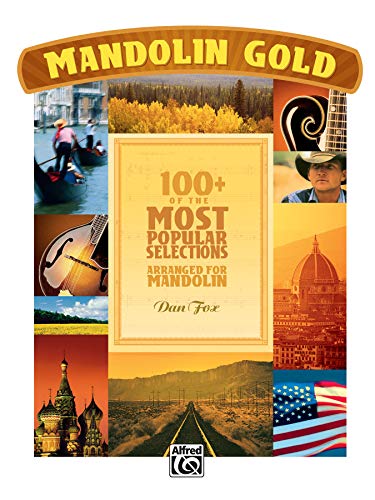
5. Best Mandolin Songbook: Mandolin Gold — Dan Fox
One of the most comprehensive classic mandolin songbooks you’ll find is Mandolin Gold: 100+ of the Most Popular Selections by Dan Fox. It showcases a massive variety of material arranged for mandolin in both standard notation and TAB. What sets this book apart from typical tune collections is its sheer breadth: over 100 selections span genres like bluegrass, old-time fiddle, classical mandolin, Irish and American folk, blues, jazz, patriotic, gospel, and even children’s and cowboy ballads. Alongside the music, you get lyrics and chord symbols for optional accompaniment, suggested finger numbers/guides, and a brief appendix with mandolin chord charts. It’s the kind of mandolin repertoire book that can keep a player busy for years and expose you to styles you might not otherwise explore.
The book also includes helpful context, like the forward on the history of the mandolin and performance notes, which adds a bit of depth for players who want more than just sheet music. Because it’s arranged for mandolin and includes TAB alongside notation, it works for players at many levels, from intermediate learners who want to expand their song library to more advanced players looking for variety and challenge. What this book does not provide is instruction, chord charts within the songs themselves, or TABs that show the rhythm. If you can’t pull the rhythm from the notation above, you’ll be challenged by some of the songs, given that there are no accompanying tracks for listening.
While it’s not specifically a beginner mandolin method book, its wide-ranging selection of tunes makes it a must-have mandolin music book for building a solid repertoire and learning how different traditions and genres fit onto the mandolin fretboard.
- Collection of well-known songs and melodies arranged for mandolin
- Features popular repertoire spanning folk, bluegrass, and traditional tunes
- Includes tablature and standard notation for accessibility and accuracy
- Designed for players who want to build playable songs quickly
- Works great as a companion to method books or for jam preparation
- Strong repertoire of recognizable tunes
- Notes and tablature included
- Great for jam sessions
- Not an instructional method
- Not tailored to absolute beginners
- Limited technique guidance
6. Best Mandolin Lick Book: 400 Smokin’ Bluegrass Mandolin Licks — Eddie Collins
400 Smokin’ Bluegrass Mandolin Licks by Eddie Collins is a valuable tool to help the aspiring jammer. It’s not for a beginner, per se. Labeled an intermediate book, this collection of riffs is designed to set you on a course to apply practical playing skills once you’ve got the basics down. It dives straight into real playing material by presenting over 400 licks built on 24 common bluegrass chord progressions, giving you a huge array of phrases you can use in solos or jams. The licks are drawn from major, pentatonic, and blues scales, and many of them incorporate core mandolin techniques like tremolo, double stops, drone strings, and cross‑picking, so you’re learning musical language that’s directly applicable to bluegrass mandolin playing. The included demo CD plays each lick at learning speed with rhythm accompaniment, making it easier to lock in timing and feel.
What makes this one of the better mandolin songbooks around is how it bridges the gap between rote exercise and practical playing. Instead of just endless drills, the phrases are tied into familiar tunes like Nine‑Pound Hammer, Salt Creek, Black Mountain Rag, Little Maggie, and Ragtime Annie, so you can hear (and use) the same ideas in a musical context. It doesn’t walk you through reading music or basic fretting concepts, but that’s not its goal. This mandolin method is a resource for expanding your improvisational skills by sharpening your vocabulary for solos and giving you material you’ll actually reach for when playing with others.
- Extensive collection of bluegrass mandolin licks and phrases
- Organized by key and musical context for easy reference
- Ideal for building improvisational vocabulary
- Includes exercises that reinforce stylistic phrasing
- Great companion for method books or jam practice
- Huge lick library
- Excellent for developing solos
- Practical jam-ready phrases
- Not a standalone method
- No basic technique instruction
- Focused solely on bluegrass style

7. Best Classic Bluegrass Mandolin Book: Bluegrass Mandolin — Jack Tottle
Among the most enduring mandolin repertoire books on the market (and highly praised) is Bluegrass Mandolin by Jack Tottle. Designed for players who want to dig deep into traditional bluegrass mandolin tunes and playing styles, this book combines standard notation and mandolin tablature for a wide selection of classic melodies. The collection draws on music from bluegrass legends like Bill Monroe, Bobby Osborne, Jesse McReynolds, Frank Wakefield, and John Duffey, giving students a chance to play some of the most beloved tunes in the genre. Songs include Arkansas Traveller, Cripple Creek, Will the Circle Be Unbroken, Boil ‘Em Cabbage Down, Old Joe Clark, Red‑Haired Boy, Blackberry Blossom, Banks of the Ohio, and many others that are staples of bluegrass jam sessions.
What sets this collection apart as a best classic bluegrass mandolin book is the way it blends instruction with real music-making. Note that it is not the best book for the pure beginner—it doesn’t cover teaching note reading and only covers basic concepts and mandolin TAB reading in a pre-guide. Then it moves straight into songs that teach authentic style and technique through practice, building the student player’s skills and ability gradually from simpler tunes to advanced pieces. The author also provides guidance on tricky sections, phrasing, and picking patterns. Tottle also dives into the structure of bluegrass songs, covering instrumental breaks, and even guides the student in how to create one’s own break—an essential skill an aspiring bluegrass mandolinist must learn eventually. All-in-all, the repertoire is both fun and educational, and the book is useful as a go‑to reference for anyone serious about playing bluegrass mandolin.
- Classic bluegrass mandolin instruction and song collection spanning basics to advanced breaks
- Features classic tunes like Arkansas Traveller, Cripple Creek, Will the Circle Be Unbroken, and more
- Combines tablature and standard notation for learning technique and repertoire
- Includes guidance on bluegrass fingerwork, rhythms, and stylistic elements
- Great reference for building practical playing skills and jam repertoire
- Excellent repertoire of classic bluegrass tunes
- Notes and tab included together
- Grows with player beyond basics
- Not tailored to absolute beginners
- No accompanying audio
- Some pieces require prior playing experience

8. Best Next-Level Mandolin Study: Masters of the Mandolin — Fred Sokolow
Masters of the Mandolin: 130 of the Greatest Bluegrass and Newgrass Solos by Fred Sokolow is a strong resource for players who are ready to move beyond beginner material and start digging into real mandolin solos. This book isn’t a traditional mandolin method book—it’s much more of a mandolin repertoire book, built around 130 note-for-note transcriptions pulled straight from classic recordings. The solos are written in mandolin tablature, and they give you a clear look at how great players actually construct lines, phrase melodies, and move through chord changes. The range of material is solid, covering foundational bluegrass players like Bill Monroe alongside modern voices such as Sam Bush and Chris Thile, with a few stylistic outliers mixed in as well.
There’s very little hand-holding here; rather, it invites you to study solos and musical ideas that have stood the test of time in bluegrass and related styles. This mandolin soloing book doesn’t explain basic technique or walk you through theory—it assumes you already have those basics and want to learn by studying real music. Working through these solos develops one’s phrasing, rhythm, and style in a way that exercises alone never really do. It’s especially useful if your goal is to improve bluegrass mandolin soloing and build a larger vocabulary of ideas you can pull from in jams, performances, or competition solos. If you’re willing to slow things down and learn material note-for-note, this is one of the better next-level mandolin books out there.
- Collection of iconic mandolin solos from bluegrass and newgrass masters
- Transcribed in precise tablature for accurate learning and study
- Covers a wide range of styles and playing approaches
- Excellent for developing improvisation and solo interpretation skills
- Ideal next-level resource for ambitious intermediate and advanced players
- Expands soloing vocabulary
- Authentic transcriptions from master players
- Bridges bluegrass and newgrass styles
- Not suitable as a beginner method
- Requires solid technique foundation
- Focused on solos, not fundamentals
9. Best Primer for Irish Tunes: Old-Time Irish Songs: Mandolin Songbook for Beginners — Peter Upclaire
Old-Time Irish Songs: Mandolin Songbook for Beginners by Peter Upclaire is an excellent choice if you want to expand your mandolin repertoire with traditional Irish and old-time melodies that feel familiar in jam sessions and solo playing alike. This songbook brings together about 40 tunes rooted in old-time and Irish traditions, with arrangements that include standard notation, tablature, chord diagrams, and lyrics, making it a truly accessible mandolin songbook for beginners who want to learn real melodies quickly. Traditional songs like The Irish Washerwoman, Rocky Road to Dublin, Meeting of the Waters, Rory O’More, and Shule Agra give the player a practical Irish repertoire, while being presented in their original scales (perfect if your goal is to one day sit in on Celtic jams).
What sets this traditional mandolin music book apart is its focus on songs with historical roots and practical ensemble use. This songbook gives players real material to practice rhythm, melody, and chord accompaniment in meaningful musical contexts. Because it includes both melody and harmony options, the student can aim for soloing, accompanying a singer, or playing with others. Many tunes also come with free online audio tracks that demonstrate how the pieces should sound, which is especially helpful for players transitioning into Celtic and Irish mandolin playing. While it doesn’t teach fundamentals like reading music from scratch or deep technique, this book shines as a mandolin beginner repertoire book that helps you use the instrument in a style very different from bluegrass, old-time, or folk, making it a strong choice for anyone expanding their musical palette beyond the basics.
- Collection of traditional Irish and old-time tunes arranged for mandolin
- Includes melodies with tabs and chords for easier learning
- Great for building repertoire for jamming or solo playing
- Focuses on cultural tunes outside typical bluegrass/folk canon
- Suitable for beginners ready to expand song library
- Wide variety of Irish/old-time tunes
- Tabs and chords included
- Builds real-world repertoire
- Not a technique method
- Limited instruction beyond songs
- Some tunes may be challenging for absolute beginners
10. Best Classical Mandolin Book: Exploring Classical Mandolin Technique and Repertoire — August Watters
For the beginning mandolin player who wants to get their feet wet in classical music, Exploring Classical Mandolin Technique & Repertoire by August Watters is one of the most detailed and musically rich mandolin instruction books available. Rather than being a basic beginner method, this book functions as both a thorough classical mandolin technique book and a curated repertoire collection grounded in tradition. It covers long-established classical techniques, from fundamental articulation and tremolo to more advanced concepts like split-string and duo-style playing, and places them within musical examples drawn from baroque, classical, and modern sources. The book is supported by online audio and video tracks in PLAYBACK+, which lets you hear demonstrations at practice-friendly tempos, slow down phrases without changing pitch, and loop difficult passages.
I had an advanced mandolin student working from this volume, and I have to say that it is not an easy one to tackle without a teacher. Given that it was authored by the Professor of Ear Training at Berklee College of Music, it will elevate your mandolin playing to an advanced level if you stick with it consistently. If not for the accompanying tracks, it would be tough to get through, and even with that, certain techniques will be tough to pick up without a visual example.
You’ll find solo pieces and ensemble arrangements by composers ranging from Fouchetti and Barbella to Beethoven, Bach, Telemann, Puccini, and Dvořák, along with original works by the author. The notation is entirely in standard music format (no tablature), making this a perfect next step for players who already read music, want to improve mandolin music reading skills, and are serious about exploring the instrument’s classical tradition in depth. Overall, this book is a great choice for long-term study and deserves its place among the best classical mandolin books on the market.
- Focuses on classical mandolin technique and stylistic repertoire
- Includes études and pieces designed to build precision, tone, and musicality
- Teaches posture, bowing/picking consistency, and phrasing for classical context
- Introduces works from historical mandolin repertoire and pedagogical studies
- Ideal for students aiming to broaden skills beyond folk or bluegrass styles
- Deep technique development
- Classical repertoire focus
- Great for formal study
- Not a beginner method
- Requires music reading experience
- Some of the repertoire is challenging for self-study

11. Best Irish Mandolin Method: Irish Mandolin Playing — Philip John Berthoud
My top pick for anyone who wants to explore Irish mandolin technique and traditional tunes from the ground up is Irish Mandolin Playing: A Complete Guide by Philip John Berthoud. This book starts with the basics of holding the instrument, tuning, and simple pick patterns, then walks you through a range of traditional forms like polkas, double jigs, hornpipes, and reels, reinforcing the style with clear, easy-to-read mandolin tablature and standard notation. What sets it apart from other mandolin instruction books is the way it blends practical playing tips with cultural context. You don’t just learn the notes, but you learn how these tunes function rhythmically and stylistically in an Irish setting. The included online audio (63 tracks) lets you hear each exercise and tune played at a sensible pace, which is a big help when you’re trying to internalize the lilt of jigs or the drive of a hornpipe.
Beyond being a valuable songbook, this mandolin guide helps students actually make progress while learning real music they’ll use. Berthoud also covers ideas like creating variations of established tunes, improvisation, and how to practice effectively, plus sections on posture, learning new tunes, and jamming with (and learning from) other musicians. If your aim is to build a strong foundation in Irish mandolin playing and develop both technique and real-world musicality, this is one of the more thorough mandolin Irish music books you’ll find. Most of the material is in tab, so you won’t need to read conventional notation, though there’s a helpful notation overview and even a chapter on modes if you want to deepen your music reading skills, too.
- Thorough guide to Irish traditional mandolin style and ornamentation
- Teaches rhythm, phrasing, and stylistic nuances unique to Irish music
- Includes tunes with notation and tablature for learning accuracy
- Focuses on melodic playing for jamming or session work
- Great resource for students exploring Celtic/folk repertoire
- Strong focus on Irish style
- Notation and tabs included
- Enhances rhythmic feel and phrasing
- Not a full beginner method
- Limited technique beyond style

12. Best Blues Mandolin Book: Mandolin Blues Book — Brent C. Robitaille
If your ears get tickled by bluesy tunes, try Mandolin Blues Book: 101 Blues Riffs and Solos for Mandolin by Brent C. Robitaille. This practical and playable blues mandolin book offers terrific, original blues material to work with once you’ve gotten some mandolin basics under your belt. The method begins with an introduction to blues and the mandolin, basic mandolin TAB instruction, blues solo creation, blues scales, and tips for soloing well. It then launches into studies in the keys of C, G, D, and A, including 40 riffs per key, and 25 one & two-bar riffs per key. Extended solos follow, as well as a deeper dive into scales and mandolin chords with focused progressions. Because the longer rhythm riffs and solos are based on the traditional 12-bar blues form, a lot of this material works well outside strict blues contexts, too. Players have used it for country, rock, jazz, and even bluegrass-tinged improv. Be aware, however, that the compositions are not classic blues repertoire, but original tunes, so you should not consider this a standard songbook; rather, a step-by-step guide to learning blues technique.
What I like about this mandolin repertoire book is that it’s focused on musical application rather than theory alone. You start with foundational stylistic riffs, then move into more complete solos, all shown in TAB that’s easy to follow. Plus, there are audio and video resources available from the author’s site so you can hear what each riff and solo should sound like. This isn’t a traditional mandolin method book, but it’s ideal as a next-step resource for players wanting to jam the blues confidently and build an expressive vocabulary rooted in real playing patterns.
- Collection of blues-style mandolin riffs, licks, and solos
- Includes examples in multiple keys for real-world playing
- Focuses on phrasing, groove, and stylistic expression in blues
- Combines exercises with musical examples to build fluency
- Great companion for expanding beyond traditional fiddle/bluegrass
- Blues phrasing emphasis
- Variety of riffs and solos
- Useful jam/practice material
- Not a full method
- No basic technique instruction

Another Book Suggestion
I didn’t want to wrap up this exploration of the best beginner mandolin books of 2026 without throwing in this last option, which is not only a practical choice for the aspiring mandolinist but also for flat-picking guitarists, banjo players, or even singers wishing to expand their knowledge of Old Time repertoire.
13. Best Mandolin Fake Book / Repertoire Builder: Bluegrass Fakebook — Bert Casey
I highly recommend the Bluegrass Fakebook by Bert Casey as a supplement to any book you are working from if you are a beginner hoping to familiarize yourself with classic bluegrass, gospel, folk, and Old Time tunes in their simplest form. This book takes a very straightforward approach: tune (in standard notation), lyrics (first verse with notation, subsequent verses in print below), and chord symbols above—basically, 150 lead sheets.
I hosted an Old Time music jam for a number of years using this book as a go-to source. As my jam was used as a tool to help students learn what jamming was all about, many of them purchased the book and referenced it when playing. Many of the songs are written in the key of G or C, which is good and bad—good for a beginner who struggles with complex sharp or flat key signatures, and good in that a lot of bluegrass music appears in those keys; bad because if you sit in on a jam and they aren’t playing in those signature keys, you’ll be challenged. Most new jammers can work around this with a capo and at least one helpful jammer in the group.
That being said, if you want to get familiar with the core tunes that jammers know, this book is a great start.
- Large collection of traditional bluegrass, gospel, and folk tunes
- Includes easy melody lines and chord symbols for jam‑ready playing
- Designed for players who want to build real‑world repertoire
- Useful reference for jam sessions or band settings
- Excellent jam repertoire
- Wide range of traditional tunes
- Great chord reference
- Not instructional
- No tablature included

Wrapping It Up
Ultimately, the best mandolin book really depends on what you’re trying to do, where you’re coming from musically, and the styles that keep you motivated to pick the instrument up every day. A classical player, a bluegrass jammer, and a blues improviser are all going to need different tools, even if they’re at the same technical level. In my experience, the most effective path is usually a combination approach: a solid method book to build technique, fretboard awareness, and structure, paired with repertoire-based books that show how those skills actually get used in real music. When you balance the “how” with the “what,” you not only improve faster, but you also stay inspired, which, in the long run, matters more than any single book choice.
FAQ: Frequently asked questions
Do some mandolin books come with an audio companion to help me learn?
Yes! Some mandolin books with audio companion materials can be really helpful — especially for beginners who want to hear how examples should sound. For instance, The Mandolin Songbook with Online Audio Access includes audio tracks for the songs it teaches, letting you listen and play along, which reinforces timing, tone, and feel much better than tablature alone. Including audio support alongside a mandolin method book or mandolin tablature book can make practice more effective and keep you in the groove as you learn.
Are books like Mandolin For Dummies or The Idiot’s Guide to Mandolin good options for learning?
To be honest, I do not recommend books such as Mandolin For Dummies or The Idiot’s Guide for Mandolin. I wouldn’t recommend them for any instrument. When I assessed a couple of versions, I found them to be over-complicated and impractical in approach. If your goal is to “read about it” in a fun overview that covers many styles and offers a lot of general information, they can be an okay choice. But I would always stick with a method by a known instrumentalist or music group that specializes in music education materials. If you want something that leans towards the former two, try this:
- Step‑by‑step beginner mandolin method designed to take a new player from zero to basic competence in two weeks
- No music reading required — uses easy‑to‑use mandolin tab and chord diagrams throughout the lessons
- Covers essential early skills including major & minor chords, right‑hand technique, left‑hand technique, tremolo picking, double stops, and essential strum patterns
- Includes complete songs and exercises presented with rhythm tab and chord frames to make practice feel like playing rather than theory
- Free play‑along audio access is available, so students can hear examples and play along at their own pace

What type of pick should I use when learning mandolin?
For beginners, a standard mandolin pick — typically a medium-to-heavy gauge flatpick — is a great place to start. Picks designed for mandolin are usually a bit thicker and stiffer than guitar picks, which helps you get a clear tone on the doubled strings and makes techniques like tremolo, crosspicking, and alternate picking easier to manage. Flatpicks with a rounded edge help smooth out string attack and give consistent sound, while heavier gauges (e.g., .73mm–.88mm) give more control for rhythm and lead lines. As you progress, you might experiment with small variations to suit your style and comfort. My preference is the pick below:
- Extra-stiff, triangular mandolin pick with rounded corners for clear, powerful attack
- Tortoise-style celluloid material produces warm tone with strong string response
- Works well for flatpicking, tremolo, and rhythm playing on mandolin and other fretted instruments
- Sturdy, long-lasting pick design ideal for jam sessions and fast playing
- Available in 12-pack

*This post may contain Amazon affiliate links or affiliate links from other companies, which means The Musically Sound earns a percentage of sales from any qualifying purchases at no additional cost to the buyer. Learn more on our Private Policy page.







Comments 1